
Planning a Deck in Colorado: Materials, Permits, and Cost
A deck in Littleton or Castle Rock has to survive intense UV, hailstorms, 60 mph wind gusts, and frost that reaches three feet into the soil. Here's what actually holds up, what jurisdictions require, and what a properly built deck costs in 2026.
Why Colorado is hard on decks
At 5,000 to 7,000 feet of elevation, UV intensity along the Front Range runs 20 to 25 percent higher than at sea level. That accelerates the breakdown of wood fibers, fades composite decking colors, and dries out sealants faster than manufacturer warranties assume. A deck that would need refinishing every three years in a humid climate often needs attention every 18 to 24 months here.
Add in hail — Denver metro sits in one of the most hail-prone corridors in the country, with damaging storms most years between May and August — and wind gusts that regularly exceed 50 mph during spring Chinook events, and you have a structure that takes more abuse than most homeowners expect. Footings also have to deal with frost heave, since undersized or shallow footings are the single most common cause of deck failure we see on remodel calls.
Frost depth and footings
Jefferson, Douglas, and Arapahoe counties require footings below the local frost line, which is typically 30 to 36 inches along the Front Range foothills and slightly less on the plains east of I-25. Littleton and unincorporated Jefferson County both enforce a 36-inch minimum footing depth for deck posts bearing on concrete piers, regardless of deck height.
Diameter matters as much as depth. A 12-inch diameter concrete pier is the common minimum for a single-story deck, but larger decks, cantilevers, or hot tub loads often require 16 to 18-inch piers sized by a structural calculation. Skipping this step is the fastest way to get red-tagged mid-project, since inspectors along the Front Range routinely check footing depth before any framing inspection is approved.
- Minimum 36" footing depth in most Denver-metro jurisdictions
- 12" diameter piers for standard loads; 16"-18" for hot tubs or cantilevers
- Footings must bear on undisturbed soil, not fill
- Helical piers are an alternative on expansive clay soils common in Douglas County
Decking material comparison
Material choice drives both upfront cost and how much maintenance the deck demands. Composite decking has become the default recommendation for most Front Range decks because it resists UV fading better than it did a decade ago and doesn't need annual staining, but it isn't maintenance-free and it costs more upfront than pressure-treated lumber.
| Material | Cost per sq ft (installed) | Lifespan | Maintenance |
|---|---|---|---|
| Pressure-treated pine | $28 - $40 | 10-15 years | Stain/seal every 1-2 years |
| Cedar | $35 - $50 | 15-20 years | Stain/seal every 2-3 years |
| Composite (capped) | $45 - $65 | 25-30 years | Wash annually, no staining |
| PVC decking | $55 - $75 | 30+ years | Wash annually, no staining |
| Ipe/tropical hardwood | $60 - $85 | 25-40 years | Oil annually to prevent silvering |
Structural framing and hardware
Ledger attachment is where most deck failures originate nationally, and it's a focus point for Front Range inspectors. Ledgers need through-bolted or lag-screwed connections with structural screws rated for the load, plus flashing that sheds water away from the house rim joist — not just caulk, which fails within a few Colorado freeze-thaw cycles.
Joist hangers, post bases, and post caps should all be hot-dip galvanized or stainless steel rated for ground contact and treated lumber's copper-based preservatives, which corrode standard electroplated hardware within a few years. This is a small cost difference on the material list but it's the difference between a deck that's solid in year 15 and one with hidden hanger corrosion by year 8.
- Through-bolted ledger connections, never relying on caulk alone for flashing
- Structural screws or lags sized to manufacturer span tables
- Hot-dip galvanized or stainless hardware for all connectors
- Joist spacing tightened to 12" on center under composite decking to prevent sag
Snow load on covered decks and pergolas
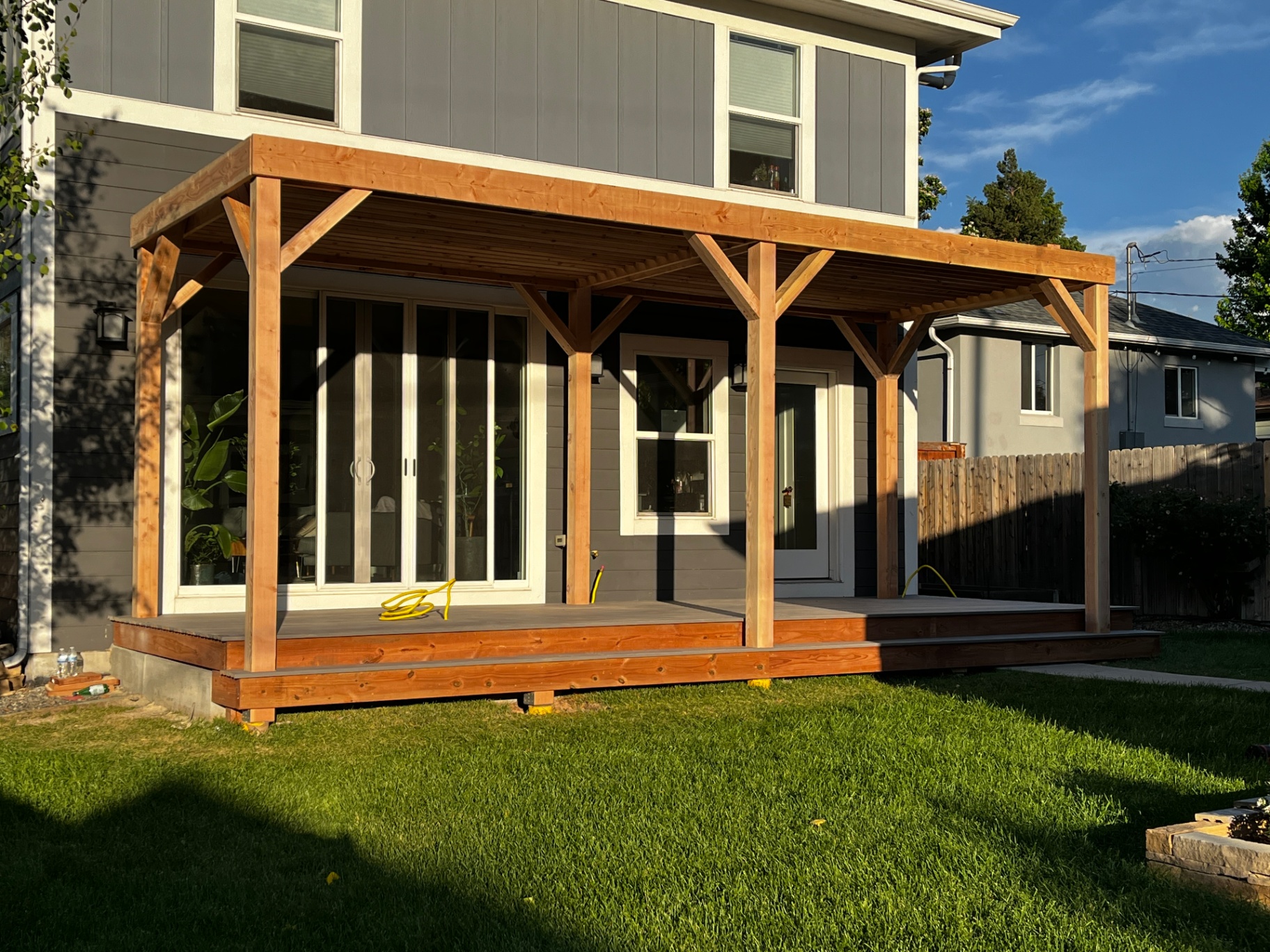
A covered deck or attached pergola is treated as a roof structure for load purposes, and Front Range jurisdictions generally require a ground snow load design value between 30 and 50 psf depending on elevation and jurisdiction — Douglas County and areas closer to the foothills often sit at the higher end. That load has to be carried down through the beam, posts, and footings, not just the rafters.
This is where undersized posts and beams show up in older DIY covered decks: a beam sized for an open deck's live load isn't necessarily sized for a solid roof carrying heavy, wet spring snow. Any covered structure over about 200 square feet typically needs stamped engineering to pull a permit in Littleton, Lone Tree, and Parker.
Permits and setbacks
Nearly every Front Range municipality requires a permit for any deck attached to the house or elevated more than 30 inches above grade, and most require one regardless of height once it's attached. Littleton, Centennial, and Aurora all require a site plan showing setbacks from property lines, easements, and any existing septic or utility infrastructure.
Typical rear-yard setbacks run 5 to 10 feet for uncovered decks and can jump to match the primary structure's setback (often 15-25 feet) once you add a roof, because a covered deck counts as additional building footprint in many zoning codes. HOAs frequently add their own rules on top of this — height limits, material and color restrictions, and required design review before a permit application even gets submitted to the county.
- Check HOA covenants before finalizing material or color choices
- Uncovered deck setbacks: typically 5-10 ft from rear/side property lines
- Covered decks may trigger the primary structure setback instead
- Decks over water features or near septic fields need additional review
Realistic cost ranges
For a 300-400 square foot ground-level deck in the Denver metro area, expect $14,000 to $28,000 depending on material, railing choice, and site access. Adding a roof structure or pergola typically adds $8,000 to $20,000 depending on span and whether it needs engineered trusses for snow load. Multi-level decks with stairs, built-in seating, or a hot tub pad push costs toward the top of these ranges or beyond.
Composite railing with aluminum balusters runs $60-$90 per linear foot installed, while cable railing systems — popular for mountain-view lots — run $100-$150 per linear foot due to the tensioning hardware and labor involved.
Maintenance schedule that actually works
Wood decks along the Front Range need a real maintenance rhythm, not just an annual glance. Because UV exposure is so aggressive here, sealant breaks down faster than package instructions suggest, and skipping a season often means sanding and re-staining rather than a simple recoat.
- Spring: inspect for hail dents, check for popped fasteners after freeze-thaw winter
- Early summer: clean with a deck-specific cleaner before staining season
- Wood decks: stain/seal every 12-24 months depending on sun exposure
- Composite/PVC: pressure wash annually at low PSI, check fastener caps
- Fall: clear debris from between boards before first snow to prevent rot pockets
- Every 3-5 years: re-torque or inspect ledger bolts and post connections